1. Understand What It Really Is — A Deduction, Not a Credit
Many teachers refer to it as a tax credit, but it is a tax deduction known as the Educator Expense Deduction.
A deduction reduces your taxable income, while a credit directly reduces the amount of tax you owe.
2. Who Qualifies for the Deduction
To claim this benefit, you must be a qualified educator. That includes:
- Teachers
- Instructors
- Counselors
- Principals
- Aides
You must work at least 900 hours during the school year in a school providing elementary or secondary education recognized by the state.
College professors or tutors do not qualify for this specific deduction.
3. The Maximum Deduction Amount
- $300 per educator (for 2022 and later years)
- $600 total if both spouses are eligible educators and filing jointly
Even if your actual spending is higher (and for most teachers it is), $300 is the maximum that can be deducted under this rule.
4. Qualifying Expenses You Can Deduct
You can claim unreimbursed expenses that are ordinary and necessary for classroom use, such as:
- Supplies (paper, pens, folders, etc.)
- Books and educational materials
- Computer equipment and software used for teaching
- COVID-19 protective items (masks, sanitizer, air filters, etc.)
- Professional development courses related to your teaching
- Instructional materials used directly by students
Always keep receipts and a log of what you bought and when. The IRS may ask for proof if your return is reviewed.
5. Where To Claim It on Your Tax Return
- Use Form 1040 or 1040-SR
- Enter your educator expenses on Schedule 1 (Form 1040), Part II – Adjustments to Income, Line 11
The total from Schedule 1 flows to Form 1040, Line 10 (Adjustments to Income).
✅ You do not need to itemize deductions to claim this — it can be used even if you take the standard deduction.
6. Married Teachers Filing Jointly
If both spouses are educators:
- Each may claim up to $300,
- Not more than $600 combined.
For example, if one spouse spent $450 and the other spent $200, you can claim $300 for one and $200 for the other, total $500.
7. Keep Good Records
You do not send receipts when you file your return, but the IRS can request them later. Keep:
- Receipts or invoices for every purchase
- Notes on the purpose of each expense
- Your school employment verification (pay stubs, contracts, or W-2s)
8. If You Spent More Than $300
You cannot deduct the rest under the educator deduction, but:
- If you are self-employed (for example, you tutor on the side), you may deduct the extra supplies under Schedule C (Business Expenses).
- You can also explore state tax deductions — some states allow higher educator expense write-offs.
9. Example of How It Works
Let us say:
- You earned $50,000 in 2024.
- You spent $400, which is not reimbursed for classroom supplies.
- You claim $300 under the educator expense deduction.
That means your taxable income becomes $49,700.
You save tax on that $300 portion — not a massive amount, but every bit helps, especially when combined with other deductions or credits.
10. Bonus Tip: Use Tax Software or a Professional
Most online tax software (like TurboTax, TaxSlayer, or H&R Block) has a specific question that asks,
“Did you spend any of your own money on classroom supplies?”
Answer “Yes,” and it will automatically apply the educator expense deduction for you.
If you have additional work expenses or multiple income sources (like tutoring or coaching), a tax professional can help you categorize them properly.
| Category | Details |
| Deduction Type | Above-the-line (available even with standard deduction) |
| Maximum Deduction | $300 ($600 for joint educators) |
| Eligible Roles | K–12 teachers, instructors, counselors, aides, principals |
| Eligible Expenses | Supplies, books, software, PD courses, PPE, tech |
| Form | Form 1040 → Schedule 1, Line 11 |
| Documentation | Keep receipts and notes for proof |
Final Thought
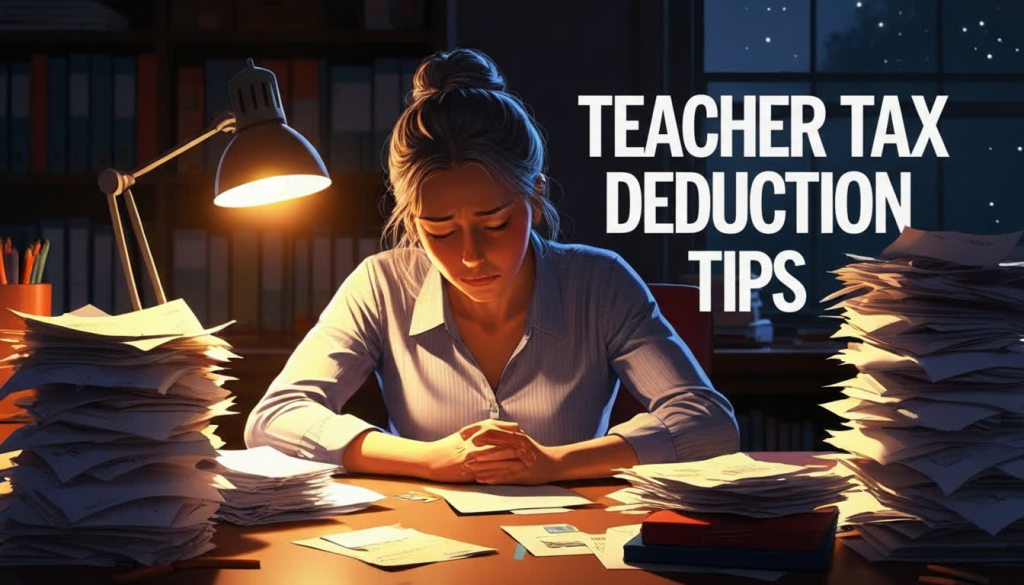
Teachers give more than lessons—they give their time, effort, and often their own money. The Educator Expense Deduction is a small token of acknowledgment from the tax system, but it hardly balances the scales. Still, claiming it correctly ensures that educators at least get the modest relief they deserve for all they invest beyond the classroom walls.
About the Author